
It’s the question everyone wants a clear answer to.
But to understand the answer, it’s important to first understand what actually makes up a mortgage interest rate.
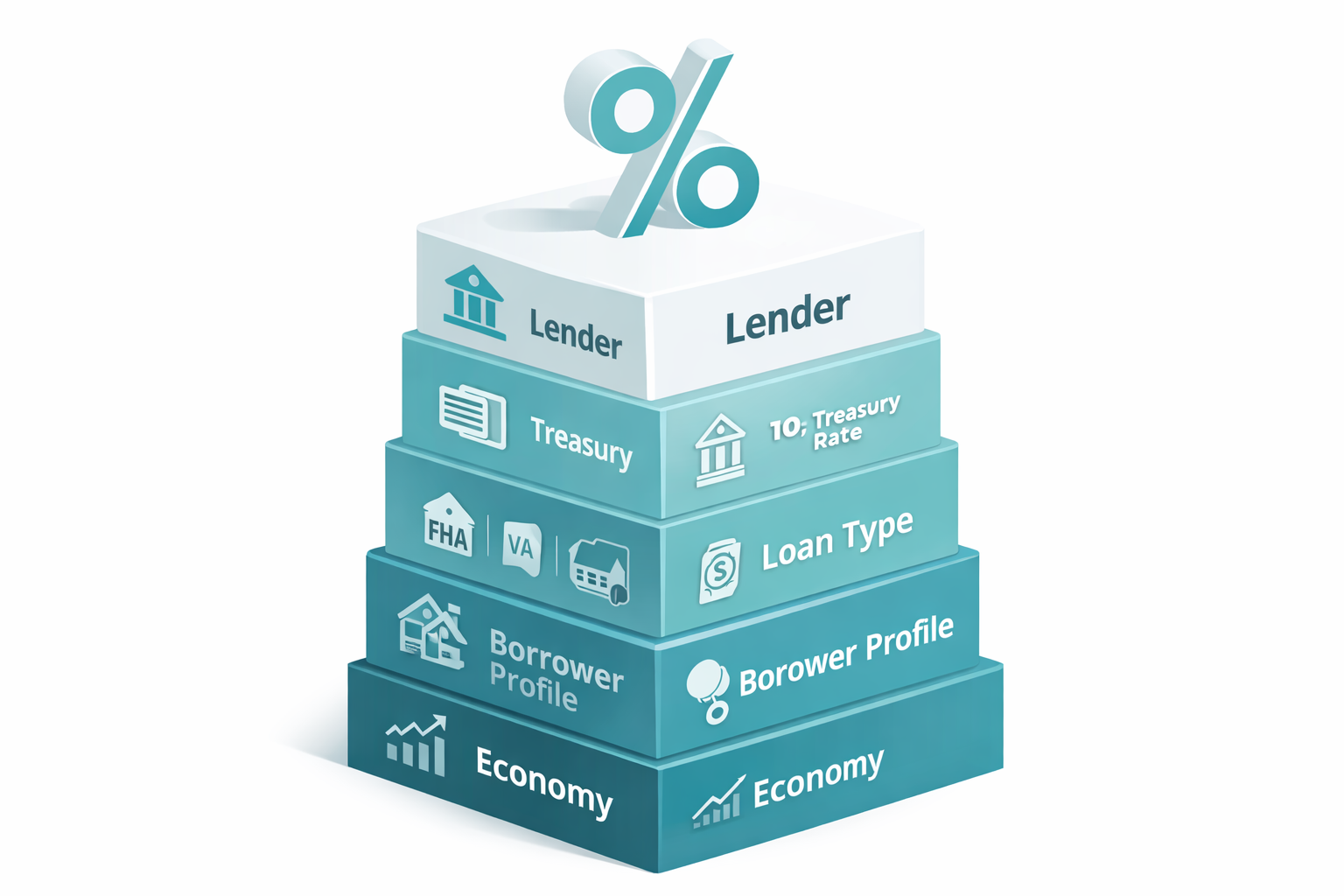
Mortgage rates are built from multiple layers that work together to determine the rate a consumer ultimately receives.
1. The Economy Sets the Tone
Investor behavior shifts depending on what’s happening in the economy:
- Periods of uncertainty (market volatility, recession concerns)
→ Investors tend to move toward more stable, conservative investments
→ Increased demand for these investments can put downward pressure on rates - Periods of strong growth (stock market performance, economic expansion)
→ Investors often pursue higher-return opportunities elsewhere
→ Lower demand for conservative investments can put upward pressure on rates
It’s the same concept as choosing between a consistent, stable (not a guaranteed) return versus a higher-risk, higher-reward opportunity.
2. The 10-Year Treasury and Mortgage-Backed Securities
At a high level, mortgage rates are typically influenced by mortgage-backed securities (MBS) and their relationship to the 10-year Treasury, as the 10-year Treasury is a common alternative investment to MBS.
Investors can choose between safe options like 10-year Treasury bonds or slightly more complex investments like mortgage-backed securities. Because MBS carry a bit more risk, they typically need to offer a higher return.
That’s where the connection comes in:
- The 10-year Treasury acts as a baseline
- Mortgage rates tend to move in relation to it
So generally:
- When the 10-year Treasury increases → mortgage rates often increase
- When it decreases → mortgage rates may decrease
Not perfectly, but historically, that’s been the trend.
3. Loan Type Changes the Starting Point
Not all mortgage rates start at the same place.
Each loan program has its own pricing structure, including:
- FHA
- VA
- Conventional
Because of this, your loan type can impact your rate before personal factors are even considered.
4. Your Personal Scenario Adjusts the Rate
This is where the biggest differences happen.
Even under the same market conditions, your individual profile plays a major role in the rate you’re offered.
- Credit Score
- Down payment amount
- Property type (single-family vs. mobile home)
- Overall loan structure
Each of these factors adjusts pricing on top of the broader market.
5. Your Mortgage Provider Also Matters
Not all providers price loans the same way.
Even when the market is the same, rates can vary depending on who you’re working with.
Some providers have:
- Higher overhead
- More layers of management
- Larger operational costs
Those factors can influence how loans are priced.
That’s why the mortgage provider you choose is another piece of the equation when it comes to the rate you’re ultimately offered.
So… Are Rates Going Up or Down?
The more important takeaway is this:
Mortgage rates are not determined by a single factor or simple prediction.
They are influenced by:
- The overall economy
- The 10-year Treasury and mortgage-backed securities
- Loan program structure
- Your personal loan profile
- Your mortgage provider
Because of this, rate movement is not a simple yes-or-no outcome—and the rate available to one borrower may differ from another at the same point in time.
Working with our team early in the process allows us to take a closer look at your full financial picture and identify potential opportunities to strengthen your position.
Even small changes can make a meaningful difference in your overall outcome.
If you’re thinking about buying, refinancing, or just want clarity, we offer a free, no-obligation review to help you understand your options.
Click the button below and a member of our team will be in contact with you within four business hours.